


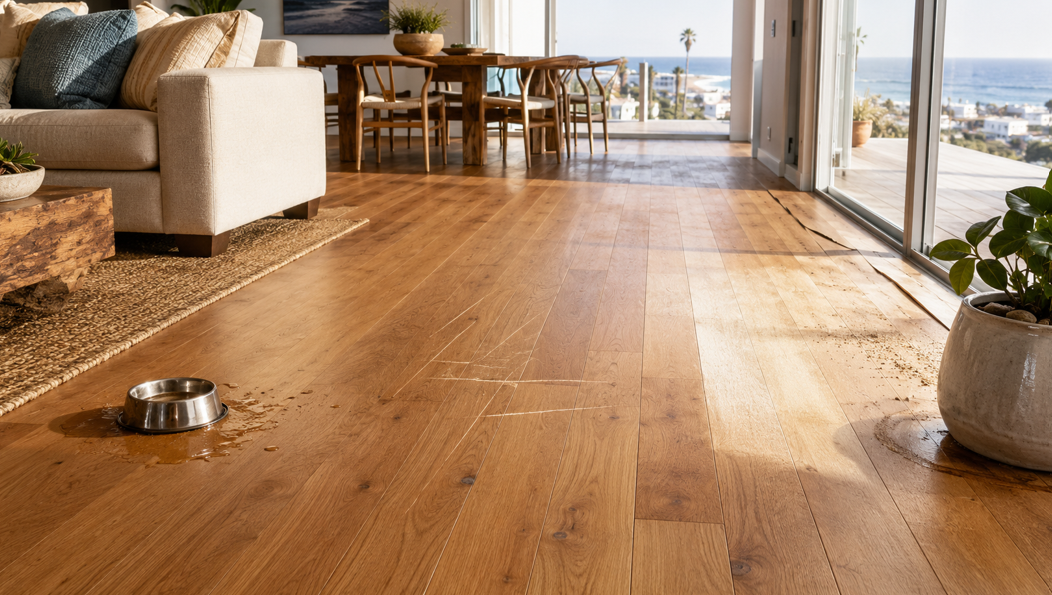
Hardwood flooring can be one of the most rewarding investments you make in your home. Natural grain, warm colour and timeless character give real wood an appeal that works across everything from relaxed coastal interiors to clean contemporary spaces.
But choosing hardwood successfully involves more than finding a beautiful sample.
The species, construction, finish, plank dimensions, installation conditions and maintenance expectations all affect how a floor performs once it becomes part of everyday life. A decision that seems minor during the selection process can become much more noticeable after hundreds of square feet have been installed.
For Costa Mesa homeowners, local lifestyle matters too. Southern California sunshine, coastal influences and active indoor-outdoor living can all affect how flooring looks and performs over time.
At Sharon and Sons, our family has spent more than 40 years helping Orange County homeowners choose flooring that fits their homes, budgets and daily routines. Many hardwood mistakes are preventable when you know what questions to ask before installation begins.
Here are seven of the most important ones to avoid.
Mistake #1: Choosing Hardwood Based Only on Colour
Colour is usually one of the first things homeowners notice when looking at hardwood.
That makes sense. Flooring covers a large visual area, and its colour has a major effect on the entire interior.
The mistake is allowing colour to become the only deciding factor.
Two hardwood floors with similar colours may perform very differently because of differences in species, construction, surface texture, finish and plank dimensions.
One might be better suited to an active family room. Another may be ideal for a quieter bedroom. A third may offer the visual style you want but require more maintenance than you expect.
Start with the room rather than the sample.
Ask how much foot traffic the floor will receive. Consider pets, children and furniture. Think about whether the flooring will continue through several connected spaces.
Then begin narrowing down colours.
This approach helps you avoid falling in love with a particular shade only to discover that the product itself does not fit your lifestyle.
Remember That Wood Is Naturally Variable
Hardwood is a natural material.
A small sample cannot represent every plank that will appear across an entire room.
Grain patterns, knots and colour variation can differ from board to board. That variation is part of the beauty of genuine wood, but homeowners should understand it before installation.
Some people love a floor with strong natural movement. Others prefer a quieter, more consistent appearance.
Neither preference is wrong.
The important thing is selecting the grade and species with realistic expectations rather than assuming every installed board will look exactly like the sample in your hand.
Mistake #2: Ignoring Natural Light
Costa Mesa homes can receive abundant Southern California sunlight, and that light has a powerful effect on flooring.
A hardwood sample viewed under showroom lighting may appear noticeably different in your home.
Warm afternoon light can emphasise golden or reddish undertones. Cooler areas of the room may make the same floor appear more muted. Large windows can also create noticeable differences between brightly lit and shaded areas.
This is why viewing samples in the intended room is so useful.
Place the sample near windows and in shaded areas. Look at it in the morning and later in the day. Compare it with the cabinets, walls and furniture already in the space.
If you are selecting several new materials for a renovation, examine them together.
A hardwood colour that appears perfect by itself may feel too warm beside a particular cabinet finish or too cool next to a countertop.
Sunlight Can Affect Wood Over Time
Natural wood may also change gradually as it is exposed to sunlight.
The exact effect depends on the species and finish.
This means rugs, large furniture and areas receiving different levels of sunlight can sometimes create variations over time.
Homeowners can help manage this by occasionally rearranging movable rugs or furnishings where practical and by considering window coverings in rooms with intense direct sun.
The goal is not to keep sunlight away from hardwood completely.
California light is one of the most appealing features of many local homes.
Instead, understand how natural materials interact with that light so that gradual change does not come as a surprise.
Mistake #3: Assuming All Hardwood Is the Same
"Hardwood flooring" describes a broad category.
It does not describe one single product.
One of the most important distinctions is between solid and engineered hardwood.
Solid hardwood is made from a single piece of timber. Depending on the particular product, it may offer the potential for multiple refinishing cycles over its lifetime.
Engineered hardwood has a genuine wood surface over a layered construction. Quality engineered products can provide the appearance and character of natural wood while offering dimensional stability that can be advantageous in certain installations.
Neither option is automatically better.
The right choice depends on the room, subfloor, installation method, product specifications and what you expect from the floor long term.
Species also matter.
Oak, maple, hickory and other woods have different grain patterns, visual characteristics and hardness levels.
Even within one species, different grades, stains and finishes can create dramatically different floors.
Before choosing hardwood flooring, look beyond the colour name and ask what you are actually buying.
Understanding the construction and characteristics of the product helps you compare flooring on meaningful terms.
Mistake #4: Picking a Trend Without Considering the Home
Flooring trends can be excellent sources of inspiration.
The problem begins when a trend becomes more important than the architecture and personality of the home.
Very wide planks, pale natural woods and low-sheen finishes may look beautiful in contemporary interiors, for example. But that does not mean every house needs exactly the same combination.
A floor should feel connected to its surroundings.
In a modern Costa Mesa home with simple lines and abundant daylight, a lighter natural wood may create an effortless, airy appearance.
In a home with Mediterranean or more traditional architectural details, slightly richer wood tones may provide better visual continuity.
The same principle applies to plank width.
Wide-plank hardwood can make an open living area feel calm and expansive, but extremely wide boards may feel disproportionate in a smaller room.
Think Beyond 2026
Hardwood is not usually a short-term design decision.
Furniture can be replaced. Walls can be repainted. Accessories can change every season.
Replacing an entire hardwood floor is a considerably larger undertaking.
That means long-term appeal deserves more weight than temporary popularity.
Instead of asking, "What hardwood is trending right now?" ask, "Would this floor still suit my home if I changed the furniture or repainted the walls five years from now?"
The strongest flooring selections often feel current without being dependent on a very specific trend.
Mistake #5: Forgetting About Everyday Life
A showroom is controlled.
Your home is not.
Shoes cross the entryway. Children play. Pets run through hallways. Chairs move backwards and forwards. Drinks spill. Grit enters from outside.
This is particularly relevant in Southern California homes where indoor-outdoor living is part of everyday life.
If family members frequently move between the house, patio and garden, flooring may encounter more fine outdoor debris than it would in a home where exterior spaces are rarely used.
That does not mean hardwood is inappropriate.
It means lifestyle should influence the product and maintenance plan.
Pets Need to Be Part of the Conversation
If you have dogs or other pets, say so when choosing flooring.
Consider how active they are, their size and which rooms they use most often.
Some homeowners prefer more textured or characterful wood because minor marks blend more naturally into the grain. Very smooth, uniform surfaces may reveal everyday wear more clearly.
The hardness of the species and durability of the finish may also influence the decision.
No natural wood floor is completely immune to scratching.
The aim should be to select a floor whose appearance and performance align with the level of activity in your home.
Entryways Deserve Extra Thought
Fine grit can behave like an abrasive when repeatedly walked across a surface.
Good-quality entrance mats can help capture outdoor debris before it travels through the house.
Regular cleaning also matters.
These simple habits may not sound exciting, but they can contribute more to the long-term appearance of hardwood than many homeowners realise.
Mistake #6: Underestimating the Importance of Installation
Beautiful hardwood deserves proper installation.
The condition of the surface underneath the flooring, the installation method, expansion requirements, transitions and finishing details can all affect the final result.
One of the biggest mistakes homeowners make is focusing heavily on the flooring product while treating installation as an afterthought.
Subfloor Preparation Matters
Hardwood needs an appropriate foundation.
If the subfloor is uneven, damaged or otherwise unsuitable, those conditions may need to be addressed first.
This is particularly important during renovations where old flooring has been removed.
The surface beneath may reveal issues that were not visible before the project began.
Addressing them can require additional work, but simply covering them with expensive new flooring is rarely the better solution.
The preparation may disappear from view once the project is complete, but its effect remains.
Moisture Conditions Need Attention
Moisture considerations should never be ignored when installing wood flooring.
The appropriate approach depends on the product, installation environment and manufacturer requirements.
If there is an existing leak or moisture-related concern in the property, that issue should be addressed before new flooring is installed.
Hardwood should not be expected to hide an underlying building problem.
Transitions Are Part of the Design
Where hardwood meets tile, carpet or another floor, the transition should be planned carefully.
Changes in flooring height may require particular solutions.
The visual result matters too, especially in open-plan homes where several flooring materials can be visible at the same time.
Good installation is not only about securing individual boards.
It is about making the entire floor feel intentional within the architecture of the home.
Mistake #7: Using the Wrong Cleaning and Maintenance Routine
Once hardwood is installed, homeowners naturally want to keep it looking beautiful.
Ironically, overly aggressive cleaning can sometimes create problems.
Hardwood generally does not benefit from excessive water.
Cleaning methods and products should always follow the recommendations provided for the particular flooring and finish.
Avoid assuming that a cleaner marketed for general household surfaces is automatically appropriate for wood flooring.
More Cleaning Product Is Not Always Better
Residue can affect how a floor looks.
Using too much cleaning product may leave the surface cloudy or dull rather than making it appear cleaner.
A simple, consistent routine is often more useful than aggressive deep cleaning.
Remove loose dust and debris regularly.
Attend to spills promptly.
Use the cleaning method recommended for your specific floor.
Protect Furniture Contact Points
Chairs and tables can place repeated stress on exactly the same areas.
Furniture pads are a simple way to reduce scratching and help protect the surface.
Check them periodically because pads can become damaged or collect grit.
When moving heavy furniture, lift it wherever practical rather than dragging it across the flooring.
Many noticeable scratches happen during furniture movement rather than normal everyday walking.
Understand That Hardwood Ages
Real wood is a natural material.
Over time, it develops evidence of the home being lived in.
The degree of change depends on the product, finish, household and maintenance routine.
For many homeowners, some natural ageing becomes part of hardwood's appeal. It develops character rather than remaining visually identical forever.
If you expect a floor to remain completely unchanged, it is worth discussing those expectations before deciding whether hardwood is the right material for you.
Bonus Mistake: Comparing Flooring by Price Alone
Price matters. Every renovation has a budget.
But comparing hardwood exclusively by price per square foot can be misleading.
One product may differ from another in species, construction, plank dimensions, grade, finish and manufacturing quality.
Installation requirements can vary too.
A lower initial material price may not represent better overall value if the product does not suit your space or design goals.
At the same time, the most expensive hardwood is not automatically the best choice.
Premium characteristics only provide value when they matter to you.
If a more characterful grade suits your aesthetic, paying extra for extremely uniform boards may offer little benefit. If standard plank dimensions work beautifully in the room, an expensive oversized format may be unnecessary.
The goal should be informed value rather than simply choosing the lowest or highest price.
Questions to Ask Before Choosing Hardwood
Avoiding mistakes becomes easier when you ask the right questions early.
Consider discussing:
Is this solid or engineered hardwood?
What species is it?
How much natural colour and grain variation should I expect?
Is the flooring appropriate for the room where I want to install it?
How will the finish handle my household's level of traffic?
What should I know if I have pets?
How will natural light affect the colour?
What type of maintenance is recommended?
What preparation does my existing floor require?
How will transitions into adjoining rooms be handled?
What should I expect from the flooring as it ages?
These questions move the conversation beyond appearance and towards how the floor will actually perform in your home.
Don't Forget the Rest of the Interior
Hardwood may cover the floor, but it is still part of a much larger design.
Consider cabinetry, countertops, wall colour, furniture and architectural details.
One common design mistake is trying to match every wood finish exactly.
That can be difficult and unnecessary.
A room often feels richer when wood tones relate to each other without being identical.
If you have wood cabinets and hardwood flooring, for example, a deliberate contrast may look more natural than two finishes that are almost the same but not quite.
Undertones matter.
Warm and cool materials can work together, but the combination should look intentional.
Viewing samples together is one of the easiest ways to understand whether the palette works.
What a Successful Hardwood Choice Looks Like
A successful hardwood floor does not need to be the trendiest, most expensive or most unusual option.
It needs to work for the home.
It should suit the architecture.
It should coordinate naturally with the broader interior.
It should provide a level of durability appropriate for the household.
And the homeowner should understand how to maintain it.
When those factors come together, hardwood can become one of the defining materials in a home rather than simply another renovation choice.
In Costa Mesa, where design-conscious interiors often meet an active Southern California lifestyle, that balance between beauty and practicality is especially important.
Make the Decision With the Whole Home in Mind
Most hardwood flooring mistakes happen when one factor receives too much attention.
Colour becomes more important than performance.
Trends become more important than architecture.
Price becomes more important than value.
The visible flooring becomes more important than preparation and installation.
Avoiding these mistakes does not require becoming a flooring expert yourself. It simply requires approaching the decision with the right questions and considering how the flooring needs to perform once it leaves the showroom and enters real life.
With more than 40 years of family experience serving Orange County, Sharon and Sons helps homeowners look at the whole picture — style, construction, lifestyle, installation and long-term expectations — before making a flooring decision.
If you are planning new hardwood floors for your Costa Mesa home and would like help comparing species, colours, plank styles and installation options, contact us to discuss your project with our experienced team.


