


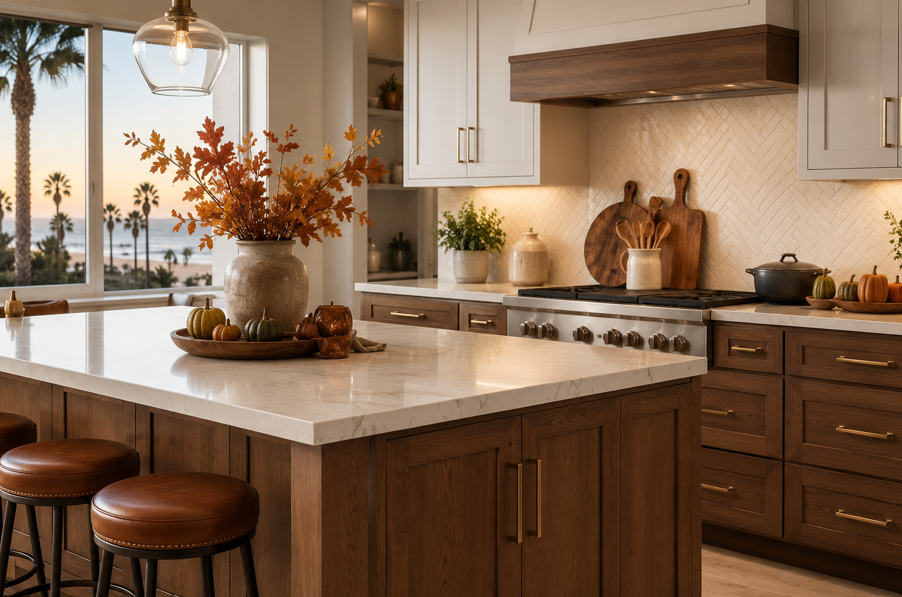
Autumn is an ideal time to rethink the kitchen. As the pace of summer begins to settle and families spend more time gathering at home, small frustrations with storage, layout and outdated finishes can become much more noticeable. A cabinet door that never closes properly, drawers that lack useful organisation or a colour scheme that no longer suits the rest of the home can all become reasons to consider a renovation.
For homeowners in Huntington Beach, fall also offers an opportunity to create a kitchen that reflects the relaxed sophistication of Southern California living. Natural materials, warm colours, practical storage and clean contemporary lines can work together to create a space that feels comfortable throughout the year rather than tied to one passing trend.
At Sharon and Sons, our family has spent more than 40 years helping Orange County homeowners make thoughtful decisions about cabinetry, flooring and complete home renovations. We have seen kitchen styles evolve considerably over that time, but one principle remains consistent: the most successful kitchens balance appearance with the practical needs of the people who use them every day.
If you are planning a fall kitchen update, cabinetry is one of the best places to begin.
Why Start Your Kitchen Renovation With the Cabinets?
Cabinets occupy a significant amount of visual space in most kitchens. They also determine much of the room's storage, organisation and day-to-day functionality.
That makes them more than a decorative feature.
Changing cabinet colour can transform the atmosphere of a kitchen. Reconfiguring drawers and storage can make food preparation easier. Extending cabinetry vertically can provide additional storage while creating a more finished architectural appearance.
Cabinet decisions can also influence many of the other choices that follow.
Countertop colour, backsplash material, hardware, flooring and lighting all interact with the cabinetry. Choosing cabinets early therefore provides a foundation for the rest of the design.
This does not mean every renovation requires replacing every cabinet.
Some kitchens need an entirely new layout. Others may benefit from updated cabinetry in selected areas, additional storage or a redesigned island. Understanding what is currently working — and what is not — helps determine the appropriate scale of the project.
Begin With How You Actually Use the Kitchen
Before choosing colours or door styles, think about your daily routine.
Where do you prepare meals?
Where do groceries accumulate when you arrive home?
Do you have enough room for pots and pans?
Are small appliances permanently occupying valuable countertop space?
Does the kitchen work comfortably when more than one person is cooking?
These questions reveal more about the right cabinet design than any trend photograph can.
A beautiful kitchen that creates frustration every morning is not truly successful.
For active Orange County households, functional storage is particularly valuable. Families may need space for school-day essentials, reusable drink bottles, entertaining pieces, speciality appliances and all the other items that modern kitchens accumulate.
Well-planned cabinets should make those belongings easier to organise rather than simply hiding them behind attractive doors.
Warm Wood Tones for an Inviting Fall Look
Fall naturally brings warmer colours into focus, but that does not require decorating a kitchen with obvious seasonal shades.
Natural wood can provide warmth in a much more lasting way.
Oak and other wood-inspired cabinet finishes introduce grain, movement and organic character. Depending on the stain and door style, wood cabinetry can feel traditional, coastal, contemporary or highly refined.
Lighter wood tones are especially effective in rooms with strong California sunlight. They can add warmth without making the kitchen feel dark or visually heavy.
Medium wood tones provide greater richness and can create appealing contrast against lighter countertops.
One effective approach is combining wood with painted cabinetry.
For example, painted perimeter cabinets paired with a natural wood island can create variation while allowing the island to act as a visual anchor. The reverse can also work, depending on the room and the existing architecture.
The goal is not to make the kitchen feel "autumnal" for a few months. It is to borrow the season's warmth and translate it into materials that remain appealing year-round.
Cream, Taupe and Soft Neutrals
White kitchens remain popular because they feel bright and adaptable, but homeowners do not need to choose stark white to achieve a light interior.
Cream, mushroom, putty, taupe and other warm neutrals can create a softer atmosphere.
These shades work particularly well with the abundant natural light common in Southern California homes. Instead of appearing cold or overly crisp, they can reflect light while maintaining warmth.
Soft neutral cabinets also provide flexibility when choosing flooring and countertops.
A cream cabinet can coordinate beautifully with natural wood flooring, warm stone, quartz and a broad range of backsplash materials.
For a more layered look, consider using slightly different neutral tones rather than making every surface identical.
A warmer cabinet finish beside a lighter countertop can produce subtle contrast while keeping the overall palette calm.
Green Cabinetry for Natural Character
Green has become an increasingly versatile cabinet colour because it can behave almost like a neutral.
Muted sage, olive and grey-green finishes pair naturally with wood, stone and warm metallic hardware.
Deeper greens can create a more dramatic effect, particularly on an island or a smaller section of cabinetry.
Green also connects naturally with the indoor-outdoor lifestyle associated with many Orange County homes. It brings an organic quality into the interior without relying entirely on natural wood.
The surrounding materials determine whether green cabinetry feels rustic or contemporary.
Pair a muted green with warm wood, handmade-looking tile and aged brass, and the result may feel relaxed and layered.
Combine a darker green with simple cabinet fronts, pale quartz and minimal hardware, and the same basic colour family can feel considerably more modern.
This versatility is one reason colour should always be considered as part of the complete material palette.
Two-Tone Kitchens Create Definition
Not every cabinet in the kitchen needs to be identical.
Two-tone cabinetry can make a large room feel more considered and can help define particular zones.
A common approach is to use one finish on the perimeter and another on the island.
This allows the island to become a focal point without requiring a dramatic countertop or unusually decorative feature.
Another option is using darker lower cabinets with lighter upper cabinetry. This can create visual weight near the floor while keeping the upper part of the room bright.
The most successful two-tone kitchens generally maintain some connection between the finishes.
That relationship may come from similar undertones, repeated hardware or a countertop that ties both cabinet colours together.
Without that connection, the kitchen can feel divided rather than layered.
Consider Cabinet Door Style Carefully
Cabinet colour attracts a great deal of attention, but door style can influence the character of the room just as strongly.
Shaker-style doors remain popular because they can move comfortably between traditional and contemporary interiors.
Simple slab or flat-panel doors create a more streamlined appearance and can work particularly well in modern renovations.
More detailed door profiles can suit homes with stronger traditional or Mediterranean architectural influences.
When choosing cabinetry, consider how the door style works with the architecture of the entire property rather than only the kitchen.
A highly contemporary cabinet may look beautiful by itself but feel disconnected in a home filled with traditional detailing.
Likewise, heavily ornate cabinetry may overpower a clean, open-plan interior.
The strongest designs acknowledge the character of the home while still allowing it to evolve.
Make the Island Work Harder
In many modern kitchens, the island has become far more than additional countertop space.
It may function as a preparation area, breakfast table, homework station, entertaining zone and storage centre all at once.
That makes the cabinetry within the island especially valuable.
Deep drawers can provide practical storage for cookware. Pull-out organisation can make frequently used items easier to reach. Seating-side storage can provide a place for less frequently used entertaining pieces.
The ends of the island can sometimes accommodate additional cabinets or display features depending on the layout.
Before designing an island around appearance alone, consider how people naturally move through the room.
An oversized island in the wrong location can create congestion rather than improve functionality.
The ideal island should support circulation, provide useful storage and complement the proportions of the kitchen.
Storage Should Be Specific, Not Generic
"More storage" sounds useful, but a successful cabinet plan should be more precise.
Think about what actually needs to be stored.
If you regularly use large pans, deep drawers may be more practical than conventional lower cabinets.
If small appliances are cluttering the countertops, an appliance storage solution may help create a cleaner working surface.
If spices are difficult to organise, narrow pull-outs or dedicated drawer inserts may provide better access.
Waste and recycling can often be incorporated into pull-out cabinetry rather than occupying separate bins in visible areas.
A pantry may benefit from adjustable shelves, internal drawers or pull-out storage that prevents items from becoming forgotten at the back.
These details rarely attract the most attention in photographs, but they can dramatically improve everyday life.
Good cabinet design is often most noticeable when you stop thinking about it because everything naturally has a place.
Upper Cabinets: Full Height or More Open Space?
One important design choice is how much cabinetry to place above the countertops.
Taking upper cabinets towards the ceiling can create additional storage and give the room a more complete, built-in appearance.
It also eliminates the difficult-to-clean gap that sometimes exists above shorter cabinets.
However, not every wall needs to be filled with cabinetry.
In some kitchens, reducing the number of upper cabinets can make the room feel lighter and create space for artwork, windows or an attractive backsplash.
Open shelving can also be used selectively, although it works best when homeowners genuinely enjoy keeping displayed items organised.
The right balance depends on storage needs.
A household with limited pantry space may value every available cabinet. Another kitchen with generous storage elsewhere may benefit visually from leaving some wall area open.
Function should guide the decision before aesthetics finalise it.
Let Natural Light Influence Your Choices
Southern California light has a strong influence on interior colour.
A cabinet sample that appears one way under showroom lighting can look warmer, cooler or considerably brighter in the actual kitchen.
For this reason, samples should be evaluated in the intended space whenever possible.
Morning and afternoon light can affect finishes differently. A west-facing kitchen may take on warmer tones later in the day, while a north-facing room may make some neutral colours appear cooler.
Hardware and countertops also change the way cabinet colours are perceived.
A warm white cabinet beside a cool grey countertop may suddenly reveal yellow undertones that were not obvious when the materials were viewed separately.
Looking at the full palette together can prevent these surprises.
Coordinate Flooring With the Cabinets
Cabinetry and flooring occupy two of the largest visual areas in a kitchen, so they should relate to each other without looking overly matched.
If the cabinets feature noticeable wood grain, the flooring does not necessarily need to use an identical colour.
In fact, slight contrast is often more successful.
Two wood finishes that are almost — but not quite — the same can sometimes appear accidental. Choosing clearly related but distinct tones can create more intentional depth.
Painted cabinets provide additional flexibility.
Warm neutrals work with many hardwood, laminate, luxury vinyl and tile styles. Darker cabinetry may benefit from lighter flooring to keep the room visually balanced.
Consider the adjoining rooms as well.
In open-plan homes, kitchen flooring often continues into dining and living areas. The cabinet finish therefore needs to make sense within a much larger visual environment.
Hardware Can Transform the Final Look
Cabinet hardware may be small, but it appears repeatedly throughout the kitchen.
Long linear pulls can reinforce a contemporary style. Smaller knobs can create a softer or more traditional appearance. Brushed brass can introduce warmth, while black hardware creates stronger contrast.
Nickel and other understated metallic finishes can blend quietly into the design.
The hardware also needs to feel comfortable.
A handle may look attractive but prove annoying if it is difficult to grip. Large drawers generally benefit from appropriately substantial pulls, while smaller doors provide greater flexibility.
The best time to choose hardware is after the broader cabinet direction has been established but before the design feels completely finished.
It should enhance the cabinetry rather than compete with it.
Think About the Kitchen Beyond Fall
Seasonal inspiration is useful, but cabinets are a long-term investment.
A colour that feels perfect for autumn should still appeal in spring. A dramatic trend should still make sense once the rest of the design world moves on.
This is why permanent materials are usually best chosen according to personal style, architecture and lifestyle rather than a single trend cycle.
Trends can still provide inspiration.
Warm woods may encourage you to reconsider natural finishes. Deep green cabinetry might reveal that you are comfortable introducing more colour. A highly organised pantry seen in a current design project may inspire better storage.
Use those ideas as starting points rather than rules.
A good renovation should feel current when completed without becoming dependent on the year it was designed.
Fall Is a Good Time to Plan the Details Together
Kitchen renovations involve many interconnected decisions.
Cabinets affect countertops. Countertops influence backsplashes. Flooring changes how cabinet colours appear. Hardware interacts with lighting and plumbing fixtures.
Approaching these choices independently can make the project unnecessarily difficult.
Instead, create a coordinated material palette.
Place cabinet samples alongside flooring, countertop and backsplash options. Compare them in natural light. Consider how hardware changes the overall character.
If something feels wrong, identify the element creating the conflict before moving forward.
This approach makes it easier to build confidence in the design as a whole.
It also reduces the temptation to make rushed decisions late in the renovation when several selections need to be finalised at once.
Design for the Way Your Family Will Live Next Year Too
A kitchen should not only accommodate today's routine.
Think about how the household may change.
Will children become more independent in the kitchen? Will ageing family members need more accessible storage? Do you expect to entertain more frequently? Could working from home make the island an occasional workspace?
Flexible storage can help the kitchen adapt.
Deep drawers, adjustable shelves and thoughtfully placed cabinets often remain useful even when the specific contents change.
This is where personalised design becomes especially valuable.
Instead of forcing your lifestyle into a generic cabinet layout, the kitchen can be planned around the way your household genuinely functions.
Create a Kitchen That Feels Warm, Practical and Personal
Fall renovation inspiration is not simply about introducing seasonal colours.
It is an opportunity to think about warmth, comfort, organisation and the way your kitchen supports everyday life.
Natural wood tones can bring organic character. Cream and taupe cabinetry can soften a bright interior. Greens can connect the kitchen with California's indoor-outdoor lifestyle. Thoughtful storage can make busy mornings easier, while a carefully planned island can become the natural gathering point of the home.
For Huntington Beach homeowners, the strongest kitchen designs often combine that practical thinking with the relaxed, design-conscious character of coastal Southern California living.
With more than 40 years of family experience serving Orange County, Sharon and Sons helps homeowners consider the complete picture — cabinetry, flooring, layout, finishes and the small details that make a renovation feel personal.
If you are considering a fall kitchen renovation and would like guidance on cabinets, storage, finishes or the broader design of your space, contact us to discuss your ideas with our experienced team.


