


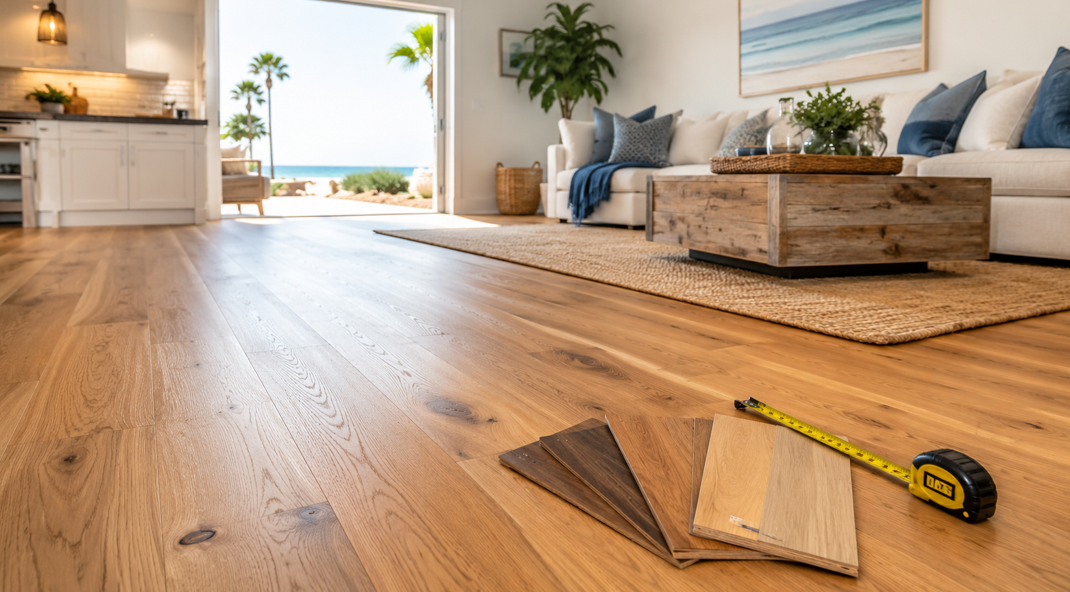
Hardwood flooring can completely change the character of a home. Natural grain, warm colour and the feeling of real wood underfoot give it an appeal that few other flooring materials can quite reproduce. But once homeowners begin considering hardwood for a renovation, one practical question usually comes first: how much will it actually cost?
For homeowners in Huntington Beach, the answer depends on much more than the square footage of the room. Wood species, solid versus engineered construction, plank width, grade, installation pattern, subfloor condition and the amount of preparation required can all influence the final investment.
As a broad 2026 planning guide, professionally installed hardwood flooring can range from roughly $6 to $25 or more per square foot nationally, while current Southern California market data shows that premium materials and more complex projects can push costs higher. Nearby Los Angeles data, for example, places many hardwood installations around $12–$22 per square foot, with some premium flooring types reaching beyond that range.
These figures are useful for initial budgeting, but they are not a substitute for a project-specific estimate. Every home is different.
At Sharon and Sons, our family has spent more than 40 years helping Orange County homeowners compare flooring based on more than price alone. The goal is to find the right balance between appearance, durability, lifestyle and budget so that the flooring still feels like the right decision years after it has been installed.
A Practical 2026 Hardwood Flooring Budget
When planning a hardwood flooring project, it helps to think in terms of ranges rather than one fixed price.
A relatively straightforward project using an accessible wood species and standard installation pattern may sit toward the lower or middle end of the market. Premium species, wider planks, higher grades, intricate layouts or substantial floor preparation can move the project considerably higher.
For a general planning exercise, homeowners might consider a range of roughly $10–$25+ per square foot for many professionally installed Southern California hardwood projects, understanding that individual projects can fall below or above this range depending on the choices involved. This is a budgeting reference, not a Sharon and Sons project quote.
Using that broad range, a homeowner might initially budget approximately:
Flooring Area | Rough Planning Range |
|---|---|
250 sq ft | $2,500–$6,250+ |
500 sq ft | $5,000–$12,500+ |
750 sq ft | $7,500–$18,750+ |
1,000 sq ft | $10,000–$25,000+ |
These examples are deliberately broad. Existing flooring removal, stairs, subfloor repairs, trims, unusual room layouts and premium design choices can all change the final cost.
The more useful question, therefore, is not simply, "What does hardwood cost per square foot?" It is, "What is included in that square-foot price?"
What Determines the Cost of Hardwood Flooring?
Several elements combine to create the final project price. Understanding them makes it much easier to compare options intelligently.
1. Solid Hardwood vs Engineered Hardwood
One of the first decisions is whether to choose solid or engineered hardwood.
Solid hardwood is manufactured from a single piece of timber. It has the traditional construction many homeowners associate with wood flooring and, depending on the product, can often be sanded and refinished multiple times over its lifespan.
Engineered hardwood uses a genuine hardwood wear layer over a layered core. High-quality engineered products can provide the same natural wood appearance while offering additional dimensional stability.
Interestingly, engineered flooring is not automatically the cheaper choice. Current 2026 Southern California pricing shows considerable overlap between solid and engineered products because quality, species, construction and finish matter just as much as the flooring type itself. Nearby Los Angeles market estimates place solid hardwood around $11–$25 per square foot and engineered hardwood around $12–$16 per square foot for many installed projects.
The better choice depends on your installation environment, desired appearance and long-term expectations rather than price alone.
2. Wood Species
Species can significantly affect both material cost and the personality of the finished floor.
Oak remains a popular choice because it offers a useful balance of durability, availability and design versatility. White oak, in particular, works beautifully with the lighter, natural finishes frequently seen in contemporary California interiors.
Other species can introduce different grain patterns, hardness levels and colours.
Maple offers a relatively clean appearance. Hickory brings stronger variation and character. More unusual or premium species may increase material costs substantially.
When comparing species, consider how you actually live in the home.
A household with pets, children and significant foot traffic may prioritise hardness and durability differently from a household choosing flooring mainly for a quieter formal living area.
Paying more for the most exotic wood available does not automatically mean you are buying the best floor for your home.
3. Wood Grade
Hardwood is available in different grades, and grade affects both appearance and price.
Some grades deliberately include more knots, mineral streaks and natural colour variation. These floors can create a relaxed, organic or rustic character.
Higher or clearer grades generally provide greater consistency from board to board, with fewer visible natural variations. Because the material must meet more selective visual standards, these products can carry a premium.
Neither is inherently better.
In fact, many design-conscious homeowners actively prefer visible variation because it makes natural wood feel authentic. Others want a quieter, more uniform floor that supports a clean contemporary interior.
The right grade is the one that supports the overall aesthetic you are trying to create.
4. Plank Width
Wide-plank hardwood remains popular in contemporary homes because fewer seams can create a more open, visually calm floor.
It can be particularly effective in bright Orange County interiors, where natural light brings out grain variation and warm wood tones throughout the day.
However, wider planks can cost more than standard-width products. Current market data indicates that wide-plank hardwood materials may range considerably depending on species and construction, with premium widths contributing to a higher overall project budget.
Rather than choosing the widest plank automatically, consider the proportions of the room.
A very wide board may look beautiful in an open-plan living area but feel visually oversized in a small bedroom or hallway. Scale matters just as much as trend.
5. Installation Pattern
A standard straight installation is generally the most economical approach because it requires less cutting and less installation time.
More decorative patterns can increase labour substantially.
Herringbone, chevron and parquet-style arrangements require precise positioning, additional cutting and greater material allowances. Current 2026 pricing data shows that complex hardwood patterns can push labour costs considerably higher than straightforward installations.
That does not mean decorative installations should be avoided.
A herringbone entry or carefully planned feature area can become one of the strongest design elements in a home. The important thing is to include the installation complexity in the budget from the beginning rather than treating it as a minor upgrade later.
Explore Hardwood Options Before Fixing Your Budget
The best way to create a realistic budget is to look at actual flooring before deciding what you expect to spend.
Two floors described simply as "white oak hardwood" can vary considerably in appearance, construction, width, grade and finish. Looking at full-size samples can reveal differences that are difficult to understand from photographs alone.
When comparing hardwood flooring, pay attention to the entire product rather than focusing only on the price per square foot.
Look at grain character. Compare finishes. Consider plank dimensions. Ask how the flooring performs in active areas. Think about whether the colour works with your cabinets, countertops and furniture.
A slightly more expensive product that fits the home beautifully may provide better long-term value than a cheaper floor you feel tempted to replace prematurely.
6. Subfloor Preparation
The flooring itself is only one part of the installation.
Hardwood needs a suitable surface beneath it. If an existing subfloor is uneven, damaged or otherwise unsuitable, additional preparation may be necessary before the new floor can be installed correctly.
This is one reason online price calculators can only go so far.
Two rooms of identical size may require dramatically different amounts of preparation.
A clean, level installation area might be relatively straightforward. Another home could require removal of existing flooring, adhesive clean-up, levelling, moisture-related evaluation or repairs before the first hardwood plank can be installed.
National 2026 cost data suggests that significant subfloor repair can add hundreds or even thousands of dollars to a flooring project depending on its extent.
Proper preparation may not be the most exciting part of a renovation, but it is one of the most important.
7. Removing Existing Flooring
Replacing carpet in an open room may involve a different level of work from removing old tile, glued flooring or several layers of previous material.
Removal and disposal can therefore affect the total budget.
When comparing estimates, ask whether removal is included.
A quote that initially appears less expensive may not necessarily represent better value if important preparation, removal or finishing work is excluded.
Comparing what is included is more meaningful than comparing only the headline total.
8. Stairs, Transitions and Finishing Details
Large uninterrupted rooms are generally easier to price than spaces containing stairs, numerous doorways or complicated transitions.
Stairs require additional cutting, fitting and specialised pieces such as stair noses. Transitions between hardwood and tile, carpet or other flooring also require careful planning.
Baseboards, mouldings and other finishing elements may need to be removed, replaced or adjusted.
Individually, these details may seem relatively small. Across a large project, however, they can make a noticeable difference to the final investment.
They also make a noticeable difference to how professional the completed floor looks.
How Huntington Beach Homes Influence Hardwood Choices
Local lifestyle should be part of the flooring conversation.
Homes near the Southern California coast often combine strong natural light, relaxed interiors and indoor-outdoor living. Those conditions can influence everything from wood colour to maintenance expectations.
Bright sunlight can gradually affect the colour of natural wood, particularly in spaces with large windows. Rugs and furniture can also create areas that receive different levels of light exposure.
Coastal living can introduce additional considerations around moisture, tracked-in sand and everyday wear.
This does not mean hardwood is unsuitable for a coastal home. It means the product, construction and finish should be selected with the environment in mind.
Engineered hardwood may appeal to homeowners seeking additional dimensional stability, while durable finishes and sensible maintenance routines can help protect the floor from an active lifestyle.
For a Huntington Beach property, the most successful floor is often one that looks refined enough for the home's design while remaining practical enough for everyday California living.
Is More Expensive Hardwood Always Better?
No.
Price can reflect meaningful differences in species, grading, construction, plank width and manufacturing quality, but a higher price does not automatically make a product better suited to your home.
Suppose one homeowner wants a highly uniform pale floor for a contemporary kitchen renovation. Another loves natural knots and colour movement.
The more expensive clear-grade product might be worth the premium for the first homeowner but unnecessary for the second.
Similarly, an exotic species may have impressive characteristics, but classic oak could coordinate better with the architecture, cabinetry and long-term design of the property.
The goal should be value, not simply the highest specification.
Good value means paying for features you will actually notice, use and appreciate.
Where Is It Worth Spending More?
If your budget has some flexibility, there are several areas where spending more can make sense.
Quality construction matters because flooring is expected to perform for years, not merely look attractive on installation day.
Professional preparation and installation are also important. Beautiful material cannot compensate for a poorly prepared surface or careless workmanship.
The right finish can be worth additional investment in a home with pets, children or significant foot traffic.
Finally, consider spending more on the areas you see most.
If hardwood will run through an open kitchen, living area and entrance, it will become one of the largest visual surfaces in the home. The difference between a floor you merely accept and one you genuinely love may justify a modest increase in the overall renovation budget.
Where Can You Control Costs?
Controlling costs does not necessarily require sacrificing quality.
Start by prioritising.
A standard plank size may provide the look you want without the premium associated with unusually wide boards. A straight installation can preserve more of the budget for better material. A naturally characterful grade may cost less than highly uniform clear wood while actually creating the warmer appearance you prefer.
You can also think strategically about where hardwood is used.
Some homeowners prefer continuous hardwood throughout major living spaces while selecting another appropriate flooring type for utility areas or rooms with different performance requirements.
Most importantly, make decisions together rather than independently.
Changing the species, width, grade, finish and pattern all at once can quickly move a project from one price category to another. Understanding which features matter most makes it easier to invest where they have the greatest impact.
Questions to Ask Before Comparing Hardwood Flooring Quotes
Price comparisons become far easier when every estimate is based on the same scope.
Before making a decision, ask what is included in the quoted figure.
Does it include the flooring material itself? What about removal of existing flooring? Is subfloor preparation included? Are trims and transitions included? Does the estimate account for stairs? Is finishing required after installation? Will furniture need to be moved?
Also ask about the product.
Is it solid or engineered? What species and grade is it? How wide and thick are the planks? Is it factory-finished? What maintenance will it require?
A detailed conversation upfront can prevent expensive surprises later.
Think Beyond the Initial Price
Hardwood flooring is usually purchased as a long-term part of the home.
That makes the lowest upfront figure only one part of the decision.
Natural hardwood has the advantage of genuine variation and depth, and many products can be renewed or refinished depending on their construction. Properly selected and maintained flooring can remain part of a home through multiple design updates.
That longevity changes how cost should be considered.
A floor that suits your lifestyle, architecture and design preferences for many years can offer greater value than an inexpensive option chosen primarily to minimise today's renovation budget.
The right choice should feel sensible financially without compromising the reason you wanted hardwood in the first place.
Plan Your Hardwood Flooring Investment With Confidence
There is no single 2026 price that applies to every hardwood flooring project. Species, construction, grade, plank width, layout, preparation and installation requirements all contribute to the final figure.
For homeowners in Huntington Beach, local conditions and lifestyle matter too. Sun-filled rooms, coastal influences and active indoor-outdoor living should be considered alongside colour and cost.
That is why seeing flooring in person and discussing the specific home can be so valuable.
With more than 40 years of family experience serving Orange County, Sharon and Sons helps homeowners evaluate these choices together — not simply choose a product based on a price tag.
If you are considering new hardwood flooring and would like to understand the options that fit your home, style and budget, contact us to discuss your project and explore flooring selections with our experienced team.


