


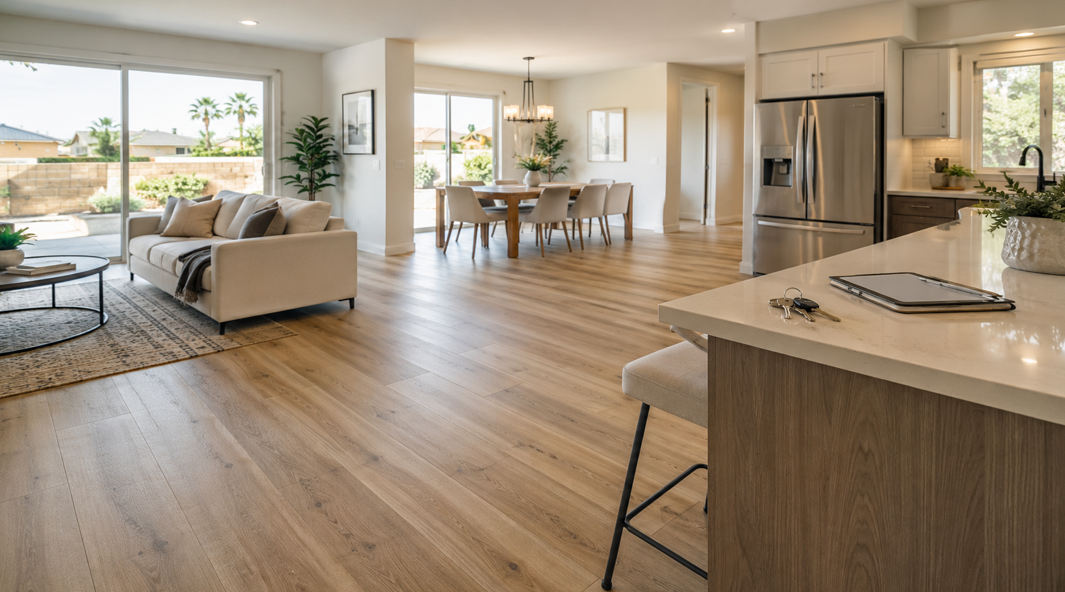
Flooring decisions look different when a property is being prepared for tenants rather than for your own household.
A homeowner may be willing to choose a highly distinctive floor because it matches a personal design vision. A rental property owner usually needs to think more broadly. The flooring should look appealing to a wide range of prospective tenants, cope with repeated use, remain relatively easy to maintain and make financial sense when considered across the life of the property.
That combination is one reason laminate flooring can be worth considering for rental and investment properties.
Modern laminate offers a broad range of realistic wood-inspired designs while providing practical characteristics that can suit active residential spaces. For landlords and property owners in Fountain Valley, it can offer an effective balance between appearance, durability and budget when the right product is selected for the right room.
At Sharon and Sons, our family has spent more than 40 years helping Orange County homeowners, businesses and property managers compare flooring based on real-world needs. In a rental, that means looking beyond the initial purchase price and considering how the flooring will perform through everyday traffic, tenant changes and ongoing property maintenance.
Why Flooring Matters in a Rental Property
Flooring is one of the largest visible surfaces in a home.
When prospective tenants walk into a property, they notice it immediately, even if they do not consciously analyse the material.
Clean, coordinated flooring can make an interior feel brighter, newer and more cared for. Worn, damaged or mismatched floors can have the opposite effect.
This makes flooring part of the property's overall presentation.
For an investment property, however, appearance cannot be the only priority.
The floor also needs to withstand daily life.
Tenants may have children or pets. Furniture may be moved during every change of occupancy. Dining chairs may be used repeatedly in the same area. Shoes bring in outdoor debris. Spills happen.
A successful rental floor therefore needs to balance presentation with resilience.
Why Laminate Can Make Sense for Investment Properties
Laminate is designed as a layered flooring product, typically combining a stable core, a decorative image and a protective surface layer.
This construction allows it to recreate the appearance of wood in a wide variety of colours and plank styles.
For landlords, several characteristics may be attractive.
Laminate can provide:
A clean, contemporary wood-look appearance
Options intended for moderate or heavy residential traffic
Straightforward routine cleaning
A wide variety of neutral designs
Useful scratch and wear resistance depending on the product
A range of price points
Consistent visual appearance across larger areas
The important qualification is depending on the product.
Not all laminate flooring offers the same level of durability, moisture protection or construction quality.
Choosing the lowest-priced product available simply because the property is a rental can create a false economy if premature replacement becomes necessary.
The better approach is to match product quality to the demands of the property.
Think in Terms of Total Value, Not Lowest Cost
Investment property decisions naturally involve budgets.
Flooring can cover hundreds or even thousands of square feet, so small differences in price per square foot can have a noticeable effect on the total project.
But the lowest material price does not always represent the lowest long-term cost.
Suppose one floor is inexpensive but shows significant wear quickly in busy areas. If it requires replacement sooner than expected, the owner may face not only another flooring bill but also labour, removal, disposal and potential downtime between tenants.
A slightly more durable product may represent better value if it remains attractive through a longer period of normal use.
This does not mean every rental needs premium flooring.
It means the decision should consider expected service life, maintenance requirements and tenant use alongside the initial cost.
For investment properties, value comes from the relationship between price and performance.
Choose a Design With Broad Appeal
A rental property is usually not the place for extremely personal flooring choices.
Bold colours, unusual patterns or strongly distinctive wood tones may appeal to some tenants while discouraging others.
Neutral flooring generally provides greater flexibility.
Natural oak looks, warm mid-tone woods and understated neutral finishes can work with a wide range of furniture, wall colours and decorating styles.
This can be particularly useful in Fountain Valley, where rental homes may attract families, professionals and long-term residents with very different tastes.
A versatile floor allows prospective tenants to imagine their own furniture in the space.
That matters.
The goal is not to create an interior with no personality. It is to provide an attractive, coherent foundation that works for many lifestyles.
Mid-Tone Flooring Can Be Particularly Practical
Very pale flooring can create a bright, modern appearance.
Very dark flooring can add drama and contrast.
For rentals, however, mid-tone designs often offer a practical compromise.
They can help disguise small amounts of dust, minor everyday debris and some visual evidence of use better than very dark or extremely light surfaces.
Wood-look variation can help too.
A floor with subtle grain movement and multiple related tones may be more forgiving than one with an extremely uniform surface.
That does not mean choosing a floor specifically to hide poor maintenance.
A rental should still be properly cleaned and cared for.
It simply means selecting a design that remains visually practical between routine cleaning sessions and under normal daily use.
Durability Should Match the Traffic Level
A one-bedroom flat occupied by one person may experience very different flooring demands from a larger rental home occupied by a family.
The appropriate laminate should reflect that difference.
One specification you may encounter when comparing products is the AC, or abrasion class, rating.
This classification relates to the flooring's ability to withstand wear under different levels of use.
For a rental property, especially one expected to experience significant foot traffic, it may make sense to consider laminate intended for heavier residential applications.
However, an abrasion rating should not be the only criterion.
Ask about the complete product.
How is the surface constructed?
What does the manufacturer say about residential use?
What warranty applies?
How does the product handle staining and scratching?
Is it suitable for the rooms where you plan to install it?
A flooring specification is valuable only when it relates to the way the property will actually be used.
Consider Tenant Turnover
Changing tenants can be hard on flooring.
Furniture is moved in and out.
Boxes are dragged through rooms.
Beds, sofas, dining tables and appliances may pass through hallways and doorways.
This concentrated activity can sometimes cause more damage than months of ordinary foot traffic.
A durable surface can therefore be particularly helpful in rental properties with regular turnover.
Good property-management practices matter too.
Furniture should be lifted rather than dragged wherever possible, and protective equipment can be used during moves.
If an owner controls the preparation between tenancies, it is worth treating flooring protection as part of the turnover process.
Preventing damage is generally easier than repairing it.
Pets Should Influence the Flooring Decision
Pet-friendly rentals can appeal to a larger tenant pool, but animals create additional flooring considerations.
Dogs may run through hallways or turn quickly on the surface. Food and water bowls introduce spill risks. Pet hair may make some flooring colours more demanding to maintain.
Laminate can be practical because many products provide a hard, relatively easy-to-clean surface.
Scratch resistance should still be considered carefully.
No flooring should automatically be described as completely scratch-proof.
A product designed for active residential use may offer stronger protection, but pet size, behaviour and household conditions can still affect the surface over time.
Texture can also matter.
A slightly textured floor may offer pets more comfortable footing than an extremely smooth surface.
For rental owners, the right combination may be a durable, subtly textured, mid-tone laminate that works visually while supporting straightforward upkeep.
Water Resistance Deserves Careful Attention
Moisture performance varies considerably between laminate products.
Traditional laminate was generally more vulnerable to water exposure, while many modern products are manufactured with improved water-resistant or waterproof characteristics.
The specific manufacturer's definition matters.
Do not assume that "water-resistant" means a floor can tolerate unlimited exposure to standing water.
For investment properties, this distinction is especially important because owners cannot control every tenant's cleaning routine or how quickly every spill is addressed.
When comparing laminate flooring, ask where the product can be installed and what the manufacturer requires for moisture protection.
Kitchens, entrances and other spill-prone areas may need different consideration from bedrooms.
If moisture is a major concern in a particular space, compare flooring types rather than forcing one material into every room.
Should You Install One Floor Throughout the Property?
Using the same flooring across several rooms can make a rental feel larger and more cohesive.
It can also simplify future maintenance.
If damage occurs and matching material is still available, having one consistent product may make repairs or partial replacements easier than maintaining several different floor styles.
Visual continuity is particularly effective in smaller or open-plan properties.
A consistent wood-look floor can help living, dining and hallway areas feel connected.
However, one-floor-everywhere is not always the best strategy.
Bathrooms, utility areas or other spaces with different performance requirements may benefit from another material.
The goal should be consistency where it makes sense, not uniformity at any cost.
Fountain Valley's Lifestyle Should Inform the Choice
Rental flooring should reflect local living conditions.
Fountain Valley is a family-oriented Orange County community where homes often need to support busy everyday routines.
That can mean regular foot traffic, children, pets, visitors and movement between indoor and outdoor spaces.
Southern California's generally bright interiors also make flooring appearance particularly important.
Strong natural light can reveal surface sheen, colour undertones and dust more clearly than dimmer environments.
A matte or low-sheen wood look can work particularly well because it supports a contemporary aesthetic without becoming overly reflective.
Warm natural colours can also coordinate effectively with the bright, relaxed interiors associated with Orange County living.
For investment properties, the objective is often to create a space that looks current and inviting without relying on a design trend that may feel dated during the next tenancy.
Avoid Flooring That Is Too Trend-Dependent
Trends can help a property look fresh.
They can also create problems when they are taken too far.
An unusual flooring colour that feels fashionable in 2026 could become much harder to coordinate with tenant furniture or future renovation choices.
A timeless neutral is usually easier to work with.
Natural wood-inspired designs have the advantage of familiarity. They can complement contemporary furniture, traditional pieces and many different colour schemes.
If you want the property to feel more current, use trend-led choices in areas that are easier to change.
Paint colours, light fixtures and hardware can often be updated more easily than flooring.
Let the floor provide a flexible base.
Installation Quality Still Matters in a Rental
It can be tempting to spend less on installation because the property is not your primary residence.
That approach can create unnecessary problems.
The floor needs an appropriate subfloor, correct preparation, suitable transitions and installation that follows the product requirements.
An uneven or improperly prepared surface may affect how the floor feels.
Poorly planned transitions can become vulnerable points between rooms.
Installation details may also influence warranties depending on the manufacturer's conditions.
A rental property benefits from professional installation for the same reason an owner-occupied home does: flooring is expected to perform after the installer leaves.
Saving money on a step that affects the entire floor can prove expensive later.
Plan for Future Repairs
Landlords should think about replacement material before an issue occurs.
If possible, retaining a reasonable quantity of matching flooring after installation may be useful for future repairs.
Products and colours change over time.
A particular laminate design that is readily available today may eventually be discontinued.
Having matching material on hand can make it easier to address localised damage without replacing a much larger area simply because the original colour cannot be found.
Storage conditions matter, so follow appropriate guidance for keeping spare flooring.
This is a relatively small planning decision that may become valuable several years later.
Make Cleaning Easy for Tenants
A rental floor should not require a highly specialised maintenance routine.
The easier the floor is to care for correctly, the more realistic it is to expect tenants to maintain it.
Provide clear care guidance.
Tenants should know which cleaning methods are appropriate and what should be avoided.
For laminate, excessive water should generally be avoided unless the product instructions specifically state otherwise.
Spills should be addressed promptly, and abrasive debris should be removed regularly.
Furniture protection is also useful.
Simple pads beneath tables and chairs can help reduce unnecessary surface marks.
Clear care instructions protect both the tenant and the property owner by reducing ambiguity about how the floor should be maintained.
Compare Laminate With Other Flooring Options
Laminate should not automatically be selected simply because the property is an investment.
Depending on the room, budget and expected use, hardwood, luxury vinyl, tile or carpet may also deserve consideration.
Hardwood offers genuine natural character and different long-term possibilities.
Carpet provides softness and acoustic comfort that may suit bedrooms.
Tile can make sense in particular moisture-prone environments.
Other resilient flooring options may offer different advantages depending on the property.
A one-stop approach to flooring can be useful because it allows the owner to compare materials based on the whole project rather than beginning with a predetermined answer.
The most profitable choice is not necessarily the least expensive floor.
It is the one that performs appropriately without requiring unnecessary investment.
Think About Resale as Well as Rental Appeal
Investment properties sometimes remain rentals for many years.
Others are eventually sold.
If resale is part of the longer-term strategy, flooring choices should support both possibilities.
Neutral, well-maintained floors can provide a broad visual foundation for future buyers just as they do for tenants.
This does not mean laminate will have the same market perception as every other flooring material.
Property type, price point and buyer expectations all matter.
In some homes, a quality laminate may provide an attractive, practical solution.
In another property positioned at a premium level, an owner may determine that hardwood better supports the intended market.
The flooring strategy should therefore reflect the entire investment plan.
Don't Forget Vacant-Property Presentation
The period between tenants is an important opportunity to evaluate flooring.
With furniture removed, wear becomes easier to see.
Inspect high-traffic paths, entrances, areas beneath dining furniture and places where previous occupants may have moved heavy items.
Address maintenance issues before photography or viewings.
A clean, consistent floor can make listing photographs look more polished and help prospective tenants feel that the property has been well cared for.
The difference does not need to be dramatic.
Rental appeal often comes from an accumulation of small signals: clean flooring, fresh walls, working hardware and a generally maintained environment.
Flooring is one of the largest of those visual signals.
Create a Consistent Specification Across Multiple Properties
Owners or property managers responsible for several rentals may benefit from creating a repeatable flooring strategy.
Instead of choosing a completely different product for every property, consider establishing preferred characteristics.
For example:
Neutral wood-inspired colours
Appropriate heavy-residential durability
Matte or low-sheen finishes
Products with suitable moisture performance
Simple plank styles
Straightforward cleaning requirements
The exact product can change over time, but a consistent specification makes future decision-making easier.
It can also help create predictable expectations for maintenance and replacement.
This approach is particularly useful for property managers who need practical solutions rather than highly customised interior designs.
Know When Replacement Makes More Sense Than Repair
Not every damaged rental floor requires complete replacement.
A localised issue may sometimes be repairable depending on the flooring system, extent of damage and availability of matching material.
However, there are situations where repeated patching no longer makes financial or visual sense.
If the floor has widespread wear, extensive moisture damage or significant colour inconsistency, replacement may provide a cleaner long-term solution.
Think about how the property presents as a whole.
A series of obvious mismatched repairs may technically solve local damage but still reduce the perceived quality of the interior.
The decision should consider cost, remaining floor life and how soon the property needs to return to the rental market.
Choose Flooring as an Investment Decision
Rental flooring has a difficult job.
It needs to appeal to people with different tastes, tolerate regular use and remain manageable from a maintenance perspective.
For Fountain Valley landlords and property owners, laminate can provide a compelling balance when it is selected carefully.
Neutral wood looks can support broad tenant appeal. Durable products can handle active residential environments. Straightforward maintenance can simplify everyday care, while a range of price points allows owners to align the floor with the property's overall positioning.
The key is to avoid thinking of rental flooring as disposable.
A better approach is to choose material whose quality makes sense for the expected traffic, tenant profile and long-term investment plan.
With more than 40 years of family experience serving Orange County, Sharon and Sons works with homeowners, businesses and property managers to compare flooring based on practical needs as well as appearance.
If you are updating a rental, preparing an investment property between tenants or comparing flooring for multiple properties, contact us to discuss your project and explore options with our experienced team.


